
Layers of Becoming
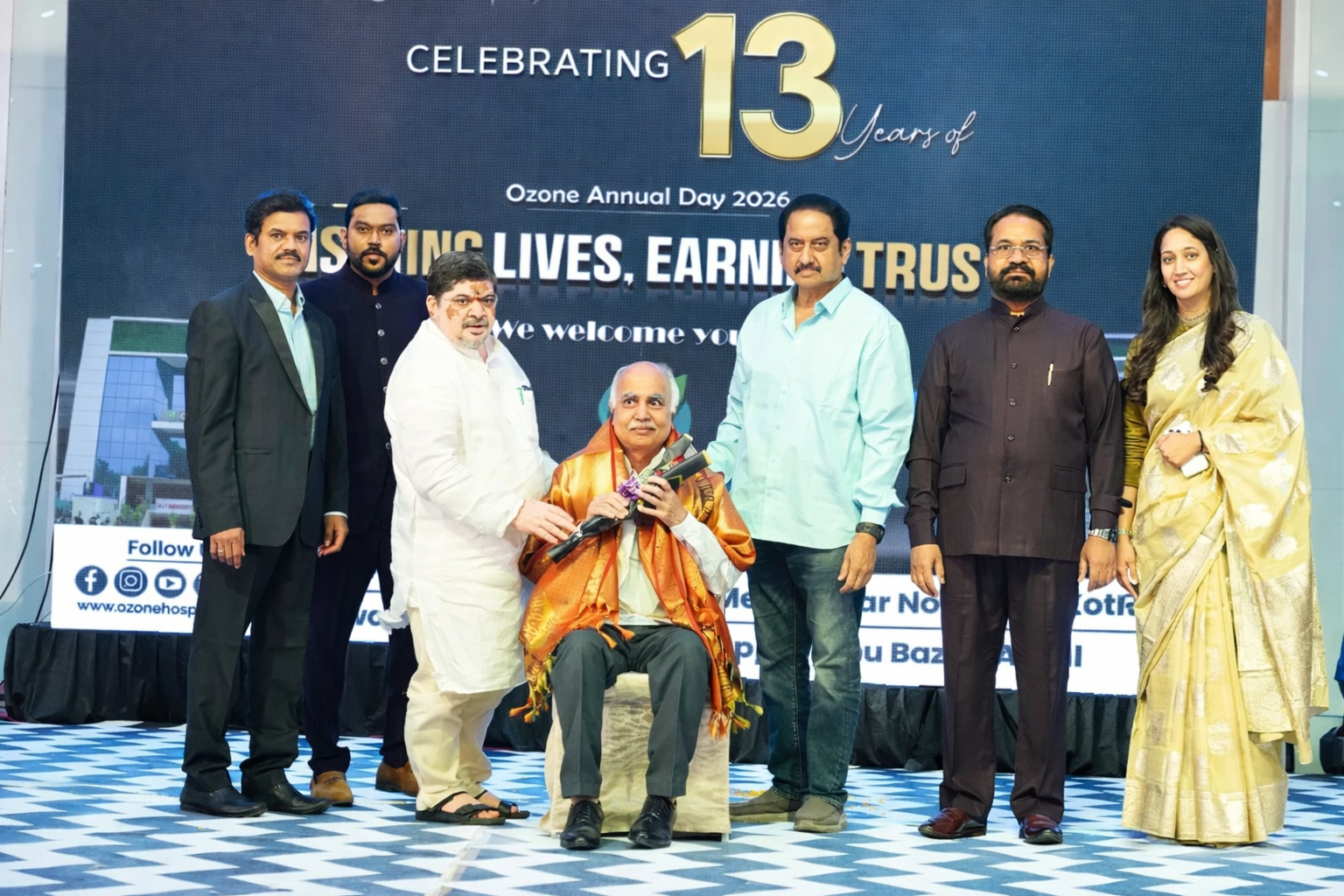
When I sat on the chair on stage to be felicitated on the 13th Foundation Day of the Ozone Hospital, on February 28, 2026, and Telangana Transport Minister Mr. Ponnam Prabhakar, Telugu film star of yesteryears Mr. Suman Talwar, and Chairman Mr. Satya Sai Prasad wrapped the ceremonial shawl around me, I wondered: Who am I? Am I the mechanical engineer who worked as a teaching associate? Or, the scientist who calculated the stress tolerances for missile structures? Am I the technologist who translated defence systems into life-saving medical devices and helped develop special steel for a coronary stent? Am I the mentee of Dr. A. P. J. Abdul Kalam, and the co-author of Wings of Fire? Or, am I someone who cannot be fitted into any system—a nobody who kept trying to be somebody?
After the glittering event, as I was driven back by my son Amol, rather than feeling elated, I felt quietly unsettled—drawn inward toward reflection. The next day, alone at home, I gazed at the photograph of my father on the bookshelf, overseeing the long, fulfilling hours I spent at my desk each day. Public perception tempts me to believe in a coherent arc—engineer to innovator, innovator to author, author to mentor. It suggests a seamless progression, as though my identity were a single, uninterrupted block carved with deliberate symmetry. Yet lived experience is rarely so orderly. What appears linear in retrospect is, in reality, shaped by pauses, detours and invisible reckonings.
The past is not one solid block. It is made up of many layers of time, built one on top of the other. Each layer was shaped by the needs and pressures of its own moment, and none of them replaces what came before. Everything remains within us—like layers of sediment in a rock, formed over time, pressed by circumstances, and quietly shaping who we are inside.
As a young mechanical engineer pursuing my master’s degree, I spent five formative years teaching engineering students. I taught kinematics—how mechanisms work, and how velocity and acceleration vectors rotate, forming instantaneous centres for the links in the mechanism. In the classroom, clarity mattered as much as correctness, and patience with young students’ queries demanded a maturity that I gained quite early in my trial by fire.
When I later joined the Defence Research & Development Organisation (DRDO) and began working on missile structures, I amazed my seniors with my clarity about the degrees of freedom in a missile’s flight path, which I acquired while teaching kinematics earlier. I effortlessly slid into the world of shear forces, bending moments, vibration modes and stress analysis. I felt as if I were walking a pre-laid-out path.
The work in the missile laboratory demanded competence and responsibility. It demanded discipline and required systems thinking. That phase trained me to respect engineering’s capacity to manufacture hardware and to account for material defects and other unforeseen factors, such as stress concentrations, which were quantified and accounted for as factors of safety. While the design must withstand the rigours of application, it must also be agile and ‘just sufficient’.
My mind felt like a fruit maturing on its tree—gathering sweetness from inquiry, firmness from responsibility, and readiness from the quiet certainty that the time to bear weight had arrived. That double urgency—pedagogical accountability while teaching in the university, and the engineering rigour of a missile laboratory—seasoned me. I learned that precision is not coldness—it is care. And it instilled a lifelong reverence for the structures, technical and intellectual, that quietly keep both machines and minds intact.
Working under Dr. A.P.J. Abdul Kalam added another layer of depth. He was not merely my Director; he became my mentor. When defence technologies began to yield civilian spinoffs, a new sense of urgency emerged—the urgency of translation. How could the rigour and materials developed for strategic purposes be redirected toward saving lives? My transition into medical innovation was not a break from my past but a reorientation of it. The moral horizon widened. Technology was no longer only about capability; it became about the urgency of compassion embedded in design. That, too, formed a layer.
Co-authoring Dr Kalam’s autobiography, Wings of Fire, introduced me to yet another urgency—the need to shape a life into a narrative so that it might continue to inspire. The book travelled into countless hands. It connected science with aspiration, discipline with dream. Being publicly known as Dr. Kalam’s pupil became part of how others saw me. But even that recognition was only sediment—one more layer formed under the pressure of responsibility and purpose.
On the stage, wrapped in an expensive silk shawl, flowers in hand, under glittering lights, all these layers converged inward. The engineer was still within me. The medical innovator stood beside him. The student of Kalam reflected quietly. The author observed. None cancelled the other. They coexisted. If someone had asked me, ‘Who are you?’ at different points in my life, the answer would have been different each time—and yet each answer would have been true in that moment. That is when the insight became clear: I am not a single, fixed identity—I am the layered imprint of all that once felt urgent.
In that reflective pause, I remembered my father. He passed away at forty-nine, before I was even employed. His absence was one of the earliest urgencies in my life—an unspoken pressure to stand firm, to honour what he had embodied, and to become steady sooner than perhaps I might otherwise have. Loss leaves a deep sediment; it quietly shapes resilience. I realised that whatever recognition I received that evening rested also on foundations he had laid long before I understood their value. All I missed that evening was seeing my father sitting in the front row, so that I might have handed him the shawl when I came down.
Now, staying mostly at home for medical reasons, I find another kind of season unfolding. Constraint has become opportunity. The hours that once belonged to travel and public engagements—entropy disguised as work—are now given instead to reading and writing, quiet acts of continuation. Even now, sedimentation continues. New urgencies arise: preserving health without surrendering purpose, mentoring without imposing, and distilling experience into wisdom rather than nostalgia. Identity remains a living formation. It is not a finished rock, but a landscape still being shaped by time, reflection and the gentle pressure of becoming.
Who am I? I am the history of my urgencies—moments that demanded action and shaped the course of my life. I am the discipline of engineering, tempered and compressed by responsibility. I am the moral expansion born of the mentorship of a great man, and the effort to translate technology into healing. In many ways, I am a narrative that tries to connect aspiration with compassion.
And yet, this story does not belong to me alone. It is a narrative of a son whose father’s life was cut short, but who drew inspiration from the elders who crossed his path. Prof. Ashok Kumar Dhol and Prof. Sharat Chandra Malviya shaped my value system. Prof. Ajay Dron and Prof. Arun Prakash moulded my emotional heart. They have all left this world, yet I can still hear their words and follow their counsel.
And then there are my students—more than two hundred of them—who pursued an MBA in Healthcare and Hospital Management at the University of Hyderabad, where I had the privilege of teaching as an adjunct professor between 2008 and 2017. Today, they are spread across the global healthcare landscape, carrying their own journeys forward—Raman in Australia, and Sama in the United States.
And how can I not think of the readers of my blogs, who pause, reflect, respond and carry my words into their own circles? In them, I sense that my life does not end with me—it extends quietly in many directions, like layers in a rock, settling, enduring, and becoming part of something larger than myself.
MORE FROM THE BLOG
Stay Awake, Stay Connected
There are certain timeless truths that can be ignored only by the most callous among us. One such truth is the Buddhist concept of Triple Refuge: Buddham saranam gacchami—I take refuge in the Buddha (the Enlightened One or Teacher); Dhammam saranam gacchami—I take...

The Unfulfilled Promise of Healthcare
Recently, I had the opportunity to spend nearly three hours in conversation at the Care Foundation, graciously hosted by its CEO, Mr. S. G. Prasad, whose quiet commitment to accessible healthcare has sustained many meaningful initiatives over the years. The meeting...

Kafka in the Age of the Gig Economy
In my youth, when I first read Franz Kafka’s Metamorphosis, published in 1915, it seemed to belong to a distant, shadowed landscape of European modernism—strange, unsettling, intellectually luminous, yet safely contained within literature. One reads differently at...

0 Comments