
A Scientist and a Gentleman
In every civilisation, there are two measures of success. One is public and noisy—titles, awards, positions, headlines, and the temporary glow of importance. The other is almost invisible: the quality of a human being. History remembers the first for a moment and the second forever. The tragedy of modern life is that we have learned to celebrate achievers and forgotten how to recognise gentlemen.
Worldly success has a remarkably brief half-life. Today’s titan becomes tomorrow’s emeritus, gracefully presiding over empty ceremonies, applauded by people who no longer rely on him. His power has vanished; only his manners remain—if he ever had any. Yet manners, ethics and inner stature are exactly what determine whether a person’s life develops into dignity or withers into bitterness.
Hollywood once tried to explain this distinction in its own way. The 1982 film, An Officer and a Gentleman, tells the story of a man who earns his stripes not through privilege but through discipline, loyalty and inner transformation. The title itself suggests something profound: that rank alone does not make one worthy—character does. In real life, however, such gentlemen are not forged on parade grounds but in the quiet spaces where no one is watching.
I learned this not from philosophers but from a scientist.
My personal journey unfolded under the long, blessed shadow of Dr. A. P. J. Abdul Kalam. For thirty-three years, I followed that rare blend of visionary and ascetic, learning how greatness can coexist with humility. Under his watchful guidance, I developed from a mechanical engineer into a missile scientist—from working with titanium for high-pressure air bottles, to designing thick-walled magnesium control bays and aluminium-alloy airframes, wings and fins, and ultimately to handling delta-ferrite-free austenitic steels for coronary stents. These were not just material changes; they represented expansions of imagination. Dr. Kalam had a profound passion for civilian spin-offs of defence technology. To him, a missile was never merely a weapon—it was a bridge to healthcare, energy and national dignity.
Through him, I encountered many remarkable minds. Yet among them all, one distinguished himself—not because he was louder, but because he was quieter. That man is Dr. Chandrasekhar Srivari.
We often assume that great scientists must be socially distant, even emotionally detached. Their minds are so immersed in abstractions that ordinary human gestures seem trivial. Like deep-sea divers, they operate below the waves, unaffected by surface noise. I expected Dr. Chandrasekhar to be like that—brilliant but removed, organised like elements in a periodic table.
Instead, the first thing he did was walk to a small fridge in his office and fetch me a bottle of water himself when I visited him for the first time in his Director’s office at the Indian Institute of Chemical Technology in Hyderabad. He did not ring a bell. He did not summon an assistant. He stood up and served. That simple act changed everything.
In that moment, I realised that I was in the presence of a different species of greatness. Not the kind that feeds on hierarchy, but the kind that dissolves it. The gentleman is not someone who expects service; he is someone who offers it.
As our meetings grew more frequent, I came to recognise the scale of Dr. Chandrasekhar’s scientific work. His approach to organic synthesis—particularly of marine natural products—was distinguished by extraordinary originality. These compounds were not merely academic curiosities; they were potential life-saving solutions for the developing world, addressing diseases like tuberculosis and malaria that continue to afflict the poor long after the rich have found cures.
His development of polyethylene glycol (PEG) as a green solvent was a quiet revolution. PEG is non-toxic, biodegradable, inexpensive, recyclable, and has low vapour pressure. In an era when chemistry is under scrutiny for its ecological footprint, this was a profound contribution. It made high-end synthesis compatible with environmental ethics.
His total synthesis of Eribulin—one of the most complex anticancer drugs ever created—was a tour de force of human intellect. It has immense commercial and medical value. And yet, outside specialist circles, almost no one knows his name. When COVID-19 shook the world, he quietly delivered a crucial adjuvant for Covaxin, contributing to one of India’s proudest scientific responses. Again, no parade followed.
Who recognises the flour-mill worker? Only the chefs are celebrated. The world observes the meal, not the milling process. It applauds the performance, not the preparation. It reveres what is visible, not what is essential. This is where the significance of the gentleman becomes vital.
A gentleman is not defined by applause. He is defined by indifference to it. His self-worth is not tethered to public recognition but to private standards. He does not ask whether he is being noticed; he asks whether he is being useful.
When I once gently asked Dr. Chandrasekhar how he felt about his work not receiving wider acclaim, he smiled—not with resignation, but with freedom. That smile told me everything. He had already transcended the marketplace of vanity. He knew that history’s truest rewards are not medals but meanings.
The gentleman lives in alignment. His actions, values and intellect are not at war with one another. He does not need to shout because he has nothing to prove. He does not hoard power because he does not fear losing it. He does not exploit people because he does not measure life in terms of extraction.
Shakespeare understood this long before modern academia. In King Lear, when the king asks his daughters to declare their love, Goneril and Regan perform eloquently. Cordelia refuses spectacle:
“I cannot heave my heart into my mouth.
I love your Majesty according to my bond; no more nor less.”
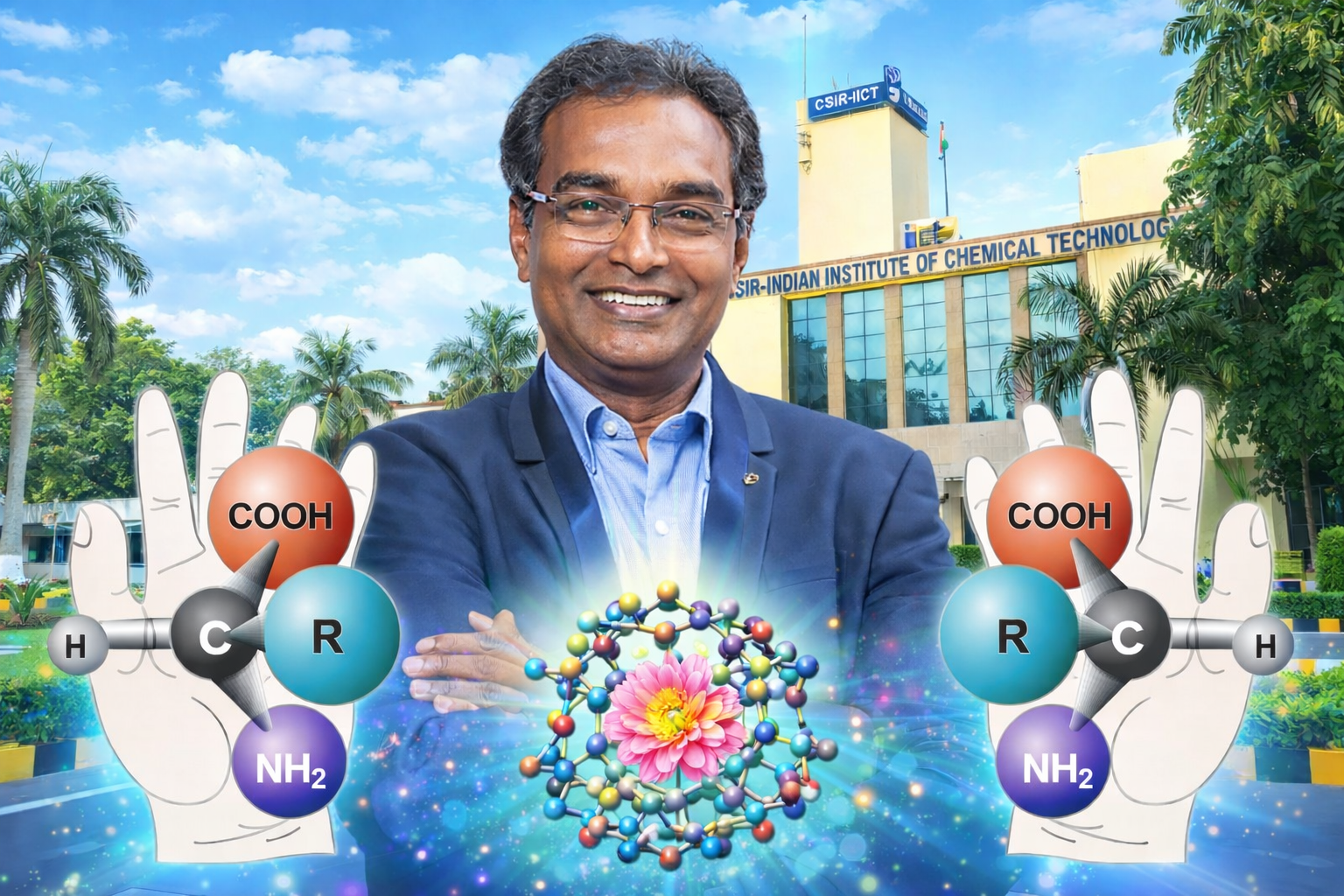
In our age of relentless self-promotion, Cordelia’s restraint is revolutionary. Dr. Chandrasekhar Srivari’s life gives that truth a scientific form. In chiral chemistry, two molecules can be mirror images—identical in structure yet opposite in effect: one healing, the other harmful. He lives that lesson. His brilliance is tempered by humility, so that knowledge is transformed into grace.
A scientist and a gentleman—this is the highest calling. In a civilisation of movers and shakers chasing visibility as a form of immortality, Dr. Chandrasekhar remains a gentleman by choice. Science, at its highest, is not merely about discovery; it is about character. A scientist who lies, plagiarises, intimidates, or exploits may produce papers, but he can never produce trust. Dr. Chandrasekhar’s ethics are not added to his intellect; they are embedded in it.
Whenever I meet him, I feel the quiet presence of Dr. Kalam—of that rare fraternity for whom knowledge is never a ladder to climb, but a light to hold for others. In such men, science does not merely advance; it acquires a soul. And in their company, one is reminded that to be a great scientist is admirable, but to be a scientist and a gentleman is a form of grace.
MORE FROM THE BLOG

The Unfulfilled Promise of Healthcare
Recently, I had the opportunity to spend nearly three hours in conversation at the Care Foundation, graciously hosted by its CEO, Mr. S. G. Prasad, whose quiet commitment to accessible healthcare has sustained many meaningful initiatives over the years. The meeting...

Kafka in the Age of the Gig Economy
In my youth, when I first read Franz Kafka’s Metamorphosis, published in 1915, it seemed to belong to a distant, shadowed landscape of European modernism—strange, unsettling, intellectually luminous, yet safely contained within literature. One reads differently at...
Those Who Transcend the Known
The best part of my career has been meeting eminent people and learning—often quietly—about the many facets of human excellence—something missed by those who pursue excellence in their own fields and live within their silos and echo chambers. Even now, when I travel...

Dear Prof. Arun Tiwari, Your piece “A Scientist and a Gentleman” is not merely a tribute to an individual — The way you weave personal experience, philosophy, literature, and scientific excellence into one seamless narrative reflects your own depth as a thinker and gentleman.
In celebrating Dr.Chandrasekhar, you have quietly restated a timeless truth — that the highest form of greatness is invisible, ethical, and selfless. Your writing does what true scholarship should do: it elevates not just a person, but the standards by which we measure greatness.
Deep respect and admiration for your clarity of thought and expression.
This title perfectly reflects your knowledge, leadership, and kindness. Fortunate to learn under a Scientist and a true Gentleman.
To be both a scientist and a gentleman is to unite intellect with integrity—where curiosity is guided by conscience, achievement tempered by humility, and success expressed through service. Such a life recognises that knowledge is received as much as it is created, and that the highest purpose of learning is to elevate human dignity. In the presence of one whose scholarship is matched by courtesy, fairness, and moral steadiness, we see that greatness is ultimately ethical rather than intellectual. Discoveries may advance civilisation for a time, but righteousness alone grants them meaning and continuity. The lasting legacy of a scientist-gentleman, therefore, lies not in what he adds to the world’s store of facts, but in the goodness and trust he leaves behind.
I consider it a privilege to work under your supervision. Your guidance and encouragement have greatly supported my academic growth. I am sincerely grateful for your kindness and continued support.
Namaste Arunji.. This article gently reminds us of a distinction we intellectually know but rarely live by — the difference between achievement and stature. In a time where visibility is mistaken for value, this portrayal of quiet excellence feels almost corrective.
The anecdote of a director personally offering water is small in action but vast in meaning — hierarchy dissolves, and character becomes visible. Perhaps civilisation advances not merely by inventions, but by such refinements of conduct.
Thank you for documenting a kind of greatness that statistics cannot measure, but memory never forgets.
Dear Sir, This is not merely a tribute to a scientist; it is a meditation on character in an age that mistakes visibility for value. Dr. Chandrasekhar Srivari exemplifies the rare confluence of intellect and humility, reminding us that true greatness is measured not by applause but by integrity. In celebrating the gentleman within the scientist, this piece restores dignity to the very idea of success. Warm Regards.
A truly stirring and necessary piece. You have illuminated a distinction that our era desperately needs to revisit….the difference between visibility and virtue. The image of a distinguished leader rising to offer something as simple as water becomes more powerful than any citation index or ceremonial honour. In that moment, hierarchy dissolves and humanity prevails. Especially striking is the idea that knowledge without moral grounding is incomplete. Technical brilliance may command attention, but only ethical steadiness commands trust. In an age saturated with self-display, your words advocate for quiet excellence, for usefulness over applause, and for alignment between mind and conscience.
A deeply moving reflection on the quiet dignity of true greatness. character—not recognition—is the real measure of a life well lived. At a time when visibility often overshadows virtue, this piece calls us back to humility, service, and integrity as the enduring foundations of both science and society.
A scientist’s true stature is revealed not solely through the brilliance of discovery, but through the quiet authority of character. Knowledge can sharpen the intellect, yet righteousness and gracious conduct give that knowledge its meaning. To be at once a scientist and a gentleman is to harmonise inquiry with integrity—where curiosity is guided by conscience, achievement softened by humility, and success translated into service. Such a life teaches us that the noblest aim of science is not recognition or power, but the gentle advancement of human well-being. In those whose learning is matched by fairness, courtesy, and moral steadiness, we see that greatness is ultimately ethical rather than intellectual. Discoveries may move civilisation forward, but it is righteousness that allows it to endure; and so the lasting legacy of a scientist-gentleman is written less in laboratories than in the trust, dignity, and goodness he leaves behind in human hearts.
A true scientist is measured not only by discovery, but by character. Knowledge may illuminate the mind, yet it is righteousness and good conduct that illuminate the human being. To be both a scientist and a gentleman is to unite intellect with integrity—where curiosity is guided by conscience, achievement tempered by humility, and success expressed through service. Such a life reminds us that the highest purpose of science is not fame, position, or accumulation of results, but the quiet enrichment of humanity. In the presence of a person whose learning is matched by courtesy, fairness, and moral steadiness, we recognise that greatness is ultimately ethical rather than intellectual. Discoveries may advance civilisation, but righteousness sustains it. Therefore, the enduring legacy of a scientist-gentleman lies not merely in what he proves in the laboratory, but in the dignity, trust, and goodness he leaves in the hearts of people.
To be both a scientist and a gentleman means to join knowledge with honesty, humility, and kindness. Curiosity should be guided by conscience, and success should be used in the service of others. Such a person understands that learning is not only about gaining facts, but about becoming a better human being. In the end, discoveries may fade with time, but a life lived with integrity and goodness continues to inspire. That is the real and lasting legacy of a scientist and a gentleman. A true scientist is measured not only by discovery but by character. All worldly achievements—titles, honours, and even celebrated breakthroughs—are ultimately transitory, and each rests upon a foundation laid by countless minds and moral inheritances that came before. What endures, therefore, is not the glitter of accomplishment but the quiet strength of righteousness and good conduct.
To be a gentleman is the essential quality, whatever the profession one chooses to follow. Knowledge, skill, and achievement may define success in the outer world, but it is character—expressed through humility, integrity, courtesy, and respect for others—that gives true meaning to a life of work. We learn these deeper values not from textbooks, but from living examples. In this regard, Dr. Chandrasekhar stands as an inspiring model of what it means to be both a fine scientist and a fine human being. His commitment to truth, his quiet discipline, his generosity toward colleagues and students, and his dignity in conduct demonstrate that scientific excellence and moral grace can walk together. Such examples shape young minds more powerfully than instruction, reminding us that the highest aim of any profession is not merely to excel in knowledge, but to elevate humanity through one’s conduct.I feel very lucky to have known Dr Chandrasekhar and Prof Tiwari as well.
Arunji, what you described here is not merely scientific brilliance but moral stature. In a world obsessed with visibility, Dr Chandrasekhar represents something rarer: significance without spectacle. His contributions to green chemistry, life-saving synthesis, and national resilience are monumental. Yet what defines him is not the scale of his work, but the humility with which he carries it.
The flour-mill worker metaphor is especially striking. Society celebrates outcomes, not origins. But without the unseen discipline of minds like his, there would be no breakthroughs to applaud. The finest achievements in science, like the strongest foundations of character, are often invisible to the crowd.
Perhaps that is the ultimate distinction between fame and greatness. Fame seeks witnesses. Greatness seeks purpose. And in that quiet smile you describe, there is the unmistakable freedom of a man who works not for recognition, but for meaning.
Arunji, Thank you for the blog on Dr Chandra Sekhar and his quiet work with out noise. Rare to find such people.
Dear Prof., What a beautiful story! It’s an aspiration to humility in life’s journey.
Thank you for quietly recognising the special person that Dr Srivari Chandrasekhar is and represents – greatness in science and humility in spirit.
Dr Srivari Chandrasekhar, my friend, neighbour, colleague and the boss. Glad to see him smiling as ever. A person of dynamic character. He should have appeared on this blog much earlier. Anyway, he is here. God bless him, and thank you, Professor Tiwari jee, for featuring him on your blog.
Arun ji, You have beautifully captured the rare combination of scientific brilliance and human humility, reminding us that true greatness lies in character and quiet dignity. As a surgeon, I see daily that the noblest professionals are those who serve with gentleness despite their achievements. Thank you for sharing this powerful lesson—it inspires us to pursue excellence while remaining grounded in humanity.
Prof Tiwari, this article is another wake-up call to us all, our children and those we teach from time to time, along life’s journey.
‘Knowledge is never a ladder to climb, but a light to hold for others. In such men, science does not merely advance; it acquires a soul. And in their company, one is reminded that to be a great scientist is admirable, but to be a scientist and a gentleman is a form of grace. May we be blessed to be the kind of people to live this reality, uncommon as it is. Thank you, my friend!
Sir, thank you very much for writing about such an important, highly valuable, knowledgeable and impactful scientist. Indeed, Dr Chandrasekhar has been a brilliant scientist and rightly recognised for his immense contribution. Truly, a very simple hero of society, having a pure loving soul, touching humanity. Thanks and regards.