
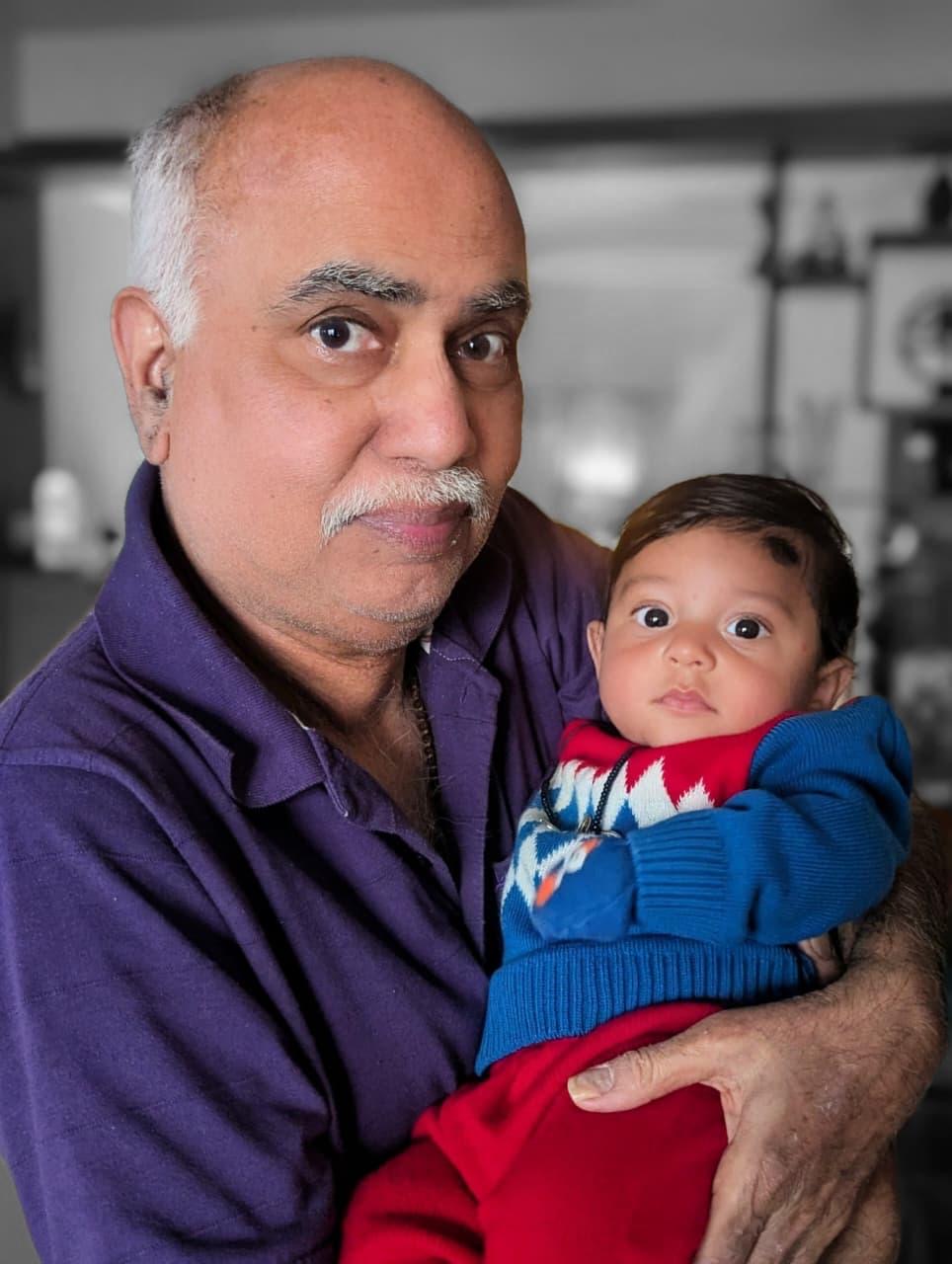
A Child and a Name in the Lila of Becoming
My younger brother Salil Tiwari’s son, Sudhanshu, and his wife, Stuti, have been blessed with a son. They live in Meerut, my hometown, and visited me recently. Like all visits involving a newborn, it carried a quiet gravity—soft footsteps, hushed voices, time slowing itself to the rhythm of breath. They have named the child Pranav, a name that is bothintimate and cosmic, tender and vast.
In Indian cosmology, Pranav is ‘Omkara’—the primordial sound from which creation unfolds. It is not merely a syllable, but a principle: the first vibration that disturbs perfect stillness and allows the universe to appear. To hold such a name in one’s arms is to be reminded that every birth is not only biological but also metaphysical.
Before sound, before form, before the long procession of time, tradition tells us there was equilibrium—a flawless balance of primordial energies. What modern language might call potential energy, kinetic energy and inertial mass, ancient thought named sattva, rajas and tamas. In that original state, none dominated. There was no motion because there was no imbalance. It was not emptiness, but fullness without expression—a silence pregnant with worlds.
Then came Pranav. Shri Krishna declares:
प्रणवःसर्ववेदेषुशब्दःखेपौरुषंनृषु।
पुण्योगन्धःपृथिव्यां च तेजश्चास्मिविभावसौ॥(Bhagavad Gita Chapter 7, Verses 8-9)
I am the sacred syllable Om in all the Vedas;I am sound in space and ability in human beings.
“I am the pure fragrance in the earthand the brilliance in fire.
The Mandukya Upanishad opens with a declaration as simple as it is total:
ॐ इतिएतदअक्षरंइदंसर्वम्
“Om is this entire universe.”
Creation does not begin with an object, but with a vibration. Om unfolds as A–U–M: waking, dreaming and deep sleep. Itfinally dissolves into silence—Turiya, the witnessing consciousness beyond all states. Sound emerges from silence, and silence remains beneath sound.
The Bhagavad Gita presents a parallel perspective, rooted not in abstraction but in real life. Shri Krishna explains that all actions stem from the interaction of the three gunas—sattva (clarity and harmony), rajas (movement and desire) and tamas (inertia and physicality). These gunas belong to Prakriti, nature itself. The Self—the witnessing consciousness—remains unaffected, taking on bodies like an actor assumes roles, entering the stage without being changed by the costume.
Seen this way, the world is a stage, but not in the trivial sense of illusion. It is a theatre of becoming, where consciousness repeatedly steps into form to experience, learn, struggle, forget, remember and evolve. Each birth is a new entry, not of something entirely new, but of something ancient continuing its journey.
A child, then, does not arrive as a blank slate alone. He arrives carrying impressions—samskaras—not as fixed destinies, but as tendencies, textures, unfinished melodies seeking expression. The Gita speaks of this continuity with startling clarity: the embodied self leaves off worn-out bodies and takes on new ones, just as a person discards old garments and dons new clothes (Chapter 2, Verse 22). The journey is uninterrupted, though the forms change.
In this sense, Pranav is not merely beginning life; he is resuming it. Consciousness has chosen a new arrangement of matter, a new family, a new historical moment, to continue its exploration of itself. The stage has shifted, the script has evolved, yet the play goes on.
What is this play? No one knows fully. Every civilisation has attempted an answer—myth, science, theology, philosophy. Today, we speak of evolution, genetics, neural networks and cosmology. Yesterday, we spoke of gods, avatars and cycles of creation and dissolution. Tomorrow, we may speak in entirely different metaphors. But beneath all explanations remains the same intuition: there is intelligence unfolding through form, and we are participants within it.
Children remind us of this truth because they arrive without explanations. They do not justify existence; they embody it. In their stillness and sudden cries, in their unfocused gaze and grasping hands, one sees the gunas awakening—rajas in movement, tamas as grounding in the physical body and its needs, sattva in the quiet clarity of presence. And behind them all, one senses the silent witness the Gita calls the ‘Akarta’—the non-doer, the one who watches the play without being bound by it
To name a child Pranav is, therefore, an act of recognition. It acknowledges that this small life is aligned with the oldest rhythm we know: vibration emerging from silence, form arising from balance, experience unfolding from stillness. It is to say that the birth of the child is not a coincidence, but an expression of family, of history, of consciousness itself.
As Sudhanshu and Stuti cradle their son, the vastness of scripture finds its most intimate proof. The MandukyaUpanishad is no longer a text; it breathes. The Gita is no longer a discourse; it lives. The cosmic sound has taken a human name.
And perhaps this is the deepest comfort these traditions offer: that life, for all its uncertainty, is not random chaos. It is Lila—a play, a game, a divine experiment whose rules are not fully known, yet whose coherence we intuit. We stumble through it, misunderstand it, suffer within it, and occasionally glimpse its beauty. That glimpse is enough to keep us playing.
Welcome, Pranav.
You enter a world that Shakespeare once saw as a stage, where men and women make their entrances and exits, each playing many parts, and you enter the same world that the Bhagavad Gita understands as a field of action, where consciousness takes form, performs its work and moves on. On this vast stage, roles change, but the witness endures. You will wear many costumes in the course of your life—child, learner, worker, giver, observer—and each role will require something different of you.
Perform each role fully and sincerely, without holding onto any mask longer than needed. Forget when forgetting is necessary, so each act can start unburdened; remember when remembrance arises so that wisdom can temper desire. Act with intention, yet be free from attachment to results, offering your work for a greater good, so your presence brings steadiness, happiness and light to those sharing the stage with you.
This world is an ongoing play—in medias res, as the Latin has it. By taking birth, we enter a story already in motion. Yesterday’s son becomes today’s father. Scenes continue to unfold, much as the same sun rises and we name it a new day. And at some moment—sooner or later—we realise that,though our role in the play was earnest and exacting, the play does not begin or end with us; that the stage, the actor and the audience all arise within a single, unbroken field of consciousness.
MORE FROM THE BLOG

The Unfulfilled Promise of Healthcare
Recently, I had the opportunity to spend nearly three hours in conversation at the Care Foundation, graciously hosted by its CEO, Mr. S. G. Prasad, whose quiet commitment to accessible healthcare has sustained many meaningful initiatives over the years. The meeting...

Kafka in the Age of the Gig Economy
In my youth, when I first read Franz Kafka’s Metamorphosis, published in 1915, it seemed to belong to a distant, shadowed landscape of European modernism—strange, unsettling, intellectually luminous, yet safely contained within literature. One reads differently at...
Those Who Transcend the Known
The best part of my career has been meeting eminent people and learning—often quietly—about the many facets of human excellence—something missed by those who pursue excellence in their own fields and live within their silos and echo chambers. Even now, when I travel...

Thank you so much, Tauji, for this incredible blessing. Reading your words about ‘Pranav’— not just as a name but as the primordial sound and a connection to the cosmic silence — was a moving experience for Stuti and me. It reminds us that his arrival is indeed part of a much larger Lila. We are deeply touched that you took the time to welcome him with such wisdom. It makes the name you gave him even more sacred to us. We feel truly blessed to have your guidance as he begins his journey on this stage.
Sir, this piece stayed with me. The way you describe the quiet meaning in something as simple as a child and a name is deeply moving. It reminded me how becoming is not loud or dramatic, but gentle and layered. Thank you for writing something so intimate and thoughtful. And a hearty welcome to the beautiful baby boy- Pranav 🙂
The three sounds—A, U, and M—represent creation, sustenance, and dissolution; waking, dreaming, and deep sleep; body, mind, and intellect. The silence that follows is equally vital—it signifies Turiya, the state beyond thought, where awareness rests in itself. It is the ground upon which all exists.
To contemplate Omkāra is to recognise that life is fundamentally rhythmic, ordered, and interconnected. Just as all words arise from sound, all forms arise from this primal resonance. Omkāra reminds us that beneath noise, conflict, and change lies an unbroken stillness. Aligning with it is not an act of belief, but of attunement—listening inward until the mind learns to settle, and the self remembers its source.
Dear Sir, Greetings! This blog is a magnificent tribute to a new life. You have turned a family visit into a cosmic revelation. The idea that ‘the Mandukya Upanishad breathes’ through a child is a reminder we all need in this distracted age. May Pranav perform his role on this vast stage with the grace and detachment you’ve described—acting with intention, yet remaining the ‘silent witness’ within. Truly inspiring.” Warm Regards.
The idea of a new birth as continuity is remarkable because it reframes change not as rupture, but as transformation within an unbroken process. In nature, nothing truly begins from zero: a seed carries the memory of the tree, a river renews itself at every bend while remaining the same river, and even the human body replaces its cells while preserving identity and function. Birth, in this sense, is not an absolute starting point but a reconfiguration of an ongoing flow.
Seen this way, continuity is the deeper law, and birth is its visible expression. What appears as an ending—of a phase, role, body, or form—is often a transition of structure, not a disappearance of essence. Energy, information, tendencies, and learning persist, reorganising themselves into new arrangements. Evolution itself works on this principle: novelty arises not by erasing the past, but by building upon it.
This perspective carries a quiet reassurance. It suggests that life is not a series of disconnected accidents, but a coherent unfolding, where each beginning inherits something meaningful from what came before. A new birth, whether biological, psychological, or spiritual, is thus continuity in motion—life’s way of renewing itself without breaking its own thread.
The idea of Omkara suggests that the universe began with a sonic vibration, implying that creation was not silent but rhythmic—more like a resonance than an explosion. It echoes ancient intuitions that reality emerged from an underlying order or frequency, where sound symbolises pattern and coherence. Whether taken metaphorically or physically, the theory reminds us that the universe may be less a machine assembled and more a harmony unfolding, governed by vibration, relation, and resonance rather than mere matter alone. God bless Pranav.
Welcome Pranav. Your parents and and family should be thankful to you for choosing them as parents…they were just a path/ road to bring you to this world. Each child has his/ her own journey. Parents dont own them- never.
Pranav’s birth, as described here, feels like the universe whispering itself into form. It is a reminder that every life participates in the timeless play of becoming. Silent, vibrant, and infinite. In his presence, the cosmic and the intimate meet, and we glimpse how consciousness quietly unfolds through each new beginning.
Dear Prof. Tiwari Ji! This is a genuinely exceptional piece that eloquently bridges the intimacy of a new arrival with the vastness of our spiritual heritage. Blessings to Pranav, and your profound reflection on the continuity of life offers a grounding perspective that is both inspiring and timeless.
What a beautiful blessing for you Prof. Tiwari and your family! Newborns like Pranav are reminders of the proof of God. What other evidence does one need. Happy for you and your family during the New Year celebration. God Bless.
Welcome, Pranav (Omkara), to Vasudeva Kutumbakum, to unfold the events for the family.
Hon’ble Tiwari sir, Pranav’s name itself has so many Samskaras and Gunas, and he will literally shine in the world. He gives so much happiness and pride to the Tiwari family and friends. Sir, so nicely narrated about Pranav, quoting references from the Bhagavad Gita and Mandukya. Indeed, evolution happens continuously, and Pranav is also going through different stages like all of us, and now, at the right place in a very prestigious, lovely, caring and sacred family, will nurture the Omkara very well. Many, many congratulations to your good self, Salil ji, for having such a great and beautiful grandson and Sudhanshu ji and Stuti for having the blessings of God Almighty in the form of lovely Pranav.
God bless Pranav, the Omkara. With regards.