
Those Who Transcend the Known
The best part of my career has been meeting eminent people and learning—often quietly—about the many facets of human excellence—something missed by those who pursue excellence in their own fields and live within their silos and echo chambers. Even now, when I travel less, Providence seems to arrange moments of rare grace: encounters with individuals whose mere presence teaches. In the presence of such people, I feel a calm, reassuring force—an affirmationthat human life, at its highest, is about the expansion of consciousness. It is about helping the mind escape the cage of instinct, habit and conditioning, and align itself with what is good beyond personal or immediate interest—towards the greater good of others.
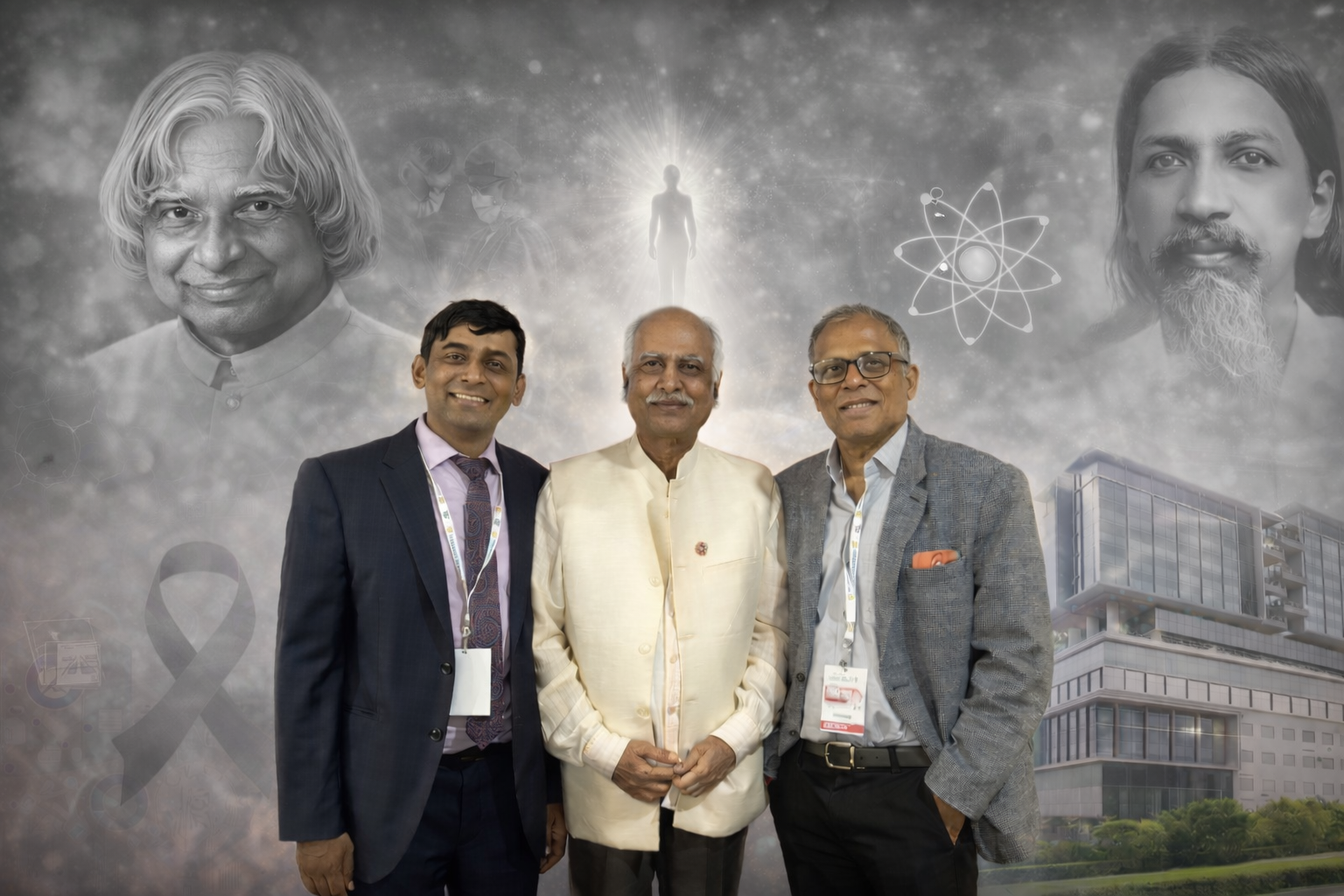
It was in this spirit that I attended the Global Head & Neck Precision Onco Summit 2026 at Yashoda Hospitals, Hyderabad, to which I was invited by Dr. S. Chinnababu, with whom I co-authored a book on cancer, Live for a Legacy, in 2023; it has recently been revised and republished in a newedition. I listened to the inaugural keynote by the globally renowned head and neck surgical oncologist Dr. Anil K. D’Cruz, and within minutes, it was evident that this was neither a performance nor an exercise in persuasion. It was the voice of a man who has spent a lifetime standing at the frontier of uncertainty—where decisions are irreversible, margins are narrow, and humility is not merely a personal virtue—it is an ethical requirement of the profession.
Dr. D’Cruz’s presence is striking—composed, precise and unsentimental. There was no sugar-coating. ‘This is what surgery can do,’ he seemed to say. ‘Beyond this lies adventurism.’ What gave these words their uncommon force was the audience before him—the very best in the field, clinicians and scientists who themselves work at the frontiers of knowledge. Yet the hall was held in attentive silence. The profundity of his words was both compelling and commanding, for they arose from strength, not hesitation. Even as a lay observer, the ethical clarity was unmistakable. Each tumour is biologically unique; each patient carries a different physiology, psychology and social context. Wise care in head and neck oncology, therefore, demands strength of judgement—an intelligent, patient-specific integration of surgery, radiation and systemic therapy, increasingly informed by molecular profiling and immuno-oncology, and anchored in the courage to respect limits. Doctors are mere professionals in their chosen field; they are not gods.
The field itself has transformed profoundly. High-resolution imaging, PET-CT fusion and intra-operative navigation have refined precision. Microvascular reconstruction restores not just anatomy but speech and swallowing. Intensity-Modulated Radiation Therapy (IMRT) and image-guided radiotherapy have reduced collateral damage. Checkpoint inhibitors targeting the transmembrane proteins programmed cell death protein 1 (PD-1) and programmed death-ligand 1 (PD-L1)have opened new options for treating recurrent and metastatic disease. Yet tools, however advanced, do not absolve us of responsibility. They extend capability; they do not replace wisdom. Without ethical restraint, technology risks becoming excessive.
This restraint is increasingly difficult in a system where medicine is no longer practised by independent agents. Every doctor is embedded in institutions—hospitals, insurers, diagnostics, and supply chains—that shape incentives and choices. Excellence today requires not only skill but resistance to the gravitational pull of profit and spectacle. It requires an elevation of consciousness commensurate with capability.
I sat with Dr. D’Cruz as co-chair during Dr. Chinnababu’spresentation on cancer prevention by traversing the last mile—away from cities, into villages and hutments, where marginalised, poor and tribal communities live. Through the Grace Cancer Foundation, a creation of his own, Dr.Chinnababu has spent over a decade raising awareness and promoting early referral. The science here is disarmingly simple: when detected early, most cancers are curable with modest intervention; when detected late, treatment becomes prolonged, costly and uncertain. Prevention and early diagnosis lack glamour. They demand patience, logistics, trust and relentless follow-up—where conscience meets competence. And there is no money in it.
As I stood between Dr. D’Cruz and Dr. Chinnababu, I felt adéjà vu—an unmistakable sensation I had experienced many times before in the company of Dr. A. P. J. Abdul Kalam. Dr.Kalam is no longer with us physically, yet some individuals never truly depart. Their way of being—how they listen, decide, pause and act—never goes away, and lives as an imprint so deep that it reappears when the conditions are right. What I felt in that moment was not nostalgia or memory. It was recognition—an experiential truth that needs no explanation, only attentiveness.
Dr. D’Cruz’s own journey exemplifies a life devoted to knowing what is not yet known. Educated at St. John’s Medical College, Bengaluru, trained in surgery at the University of Mumbai, and forged over 38 years at Tata Memorial Hospital—including 28 as Professor and Head—he has helped define standards of care respected worldwide. Since 2019, as Director of Oncology at Apollo Hospitals, he has shown that disciplined excellence and large systems need not be incompatible. His legacy lies not only in surgeries and publications, but in generations trained to think before they cut, to ponder before they decide, and to respect biology over ego.
Watching Dr. D’Cruz draw firm ethical boundaries around intervention, and Dr. Chinnababu persistently widen the circle of care to include those whom systems routinely forget, I sensed the same inner alignment I had witnessed years earlier. It was the lived coherence between thought and action, between capability and responsibility. Such moments reveal themselves not through argument or ideology, but through experience—and it is from this realm of lived experience that thinkers like Sri Aurobindo spoke of a higher order of consciousness made visible in ordinary human work.
These are the people Sri Aurobindo described in The Life Divine—not saints withdrawn from the world, but individuals fully embodied in work, inwardly governed by something larger than ambition or fear. Such people do not announce their spirituality. They live it through precision, discipline and care. In medicine, this quality is unmistakable: the courage to say ‘no’ when intervention will harm; the choice of prevention over spectacle; the building of institutions rather than empires; the teaching of when not to act.
Sri Aurobindo argued that human evolution is ethical and conscious, not merely technological. The next step would be taken by individuals who master inner compulsions while remaining fully engaged with the world. At the Summit, I saw this principle enacted—quietly—by a master surgeon who knows his limits and a public-health clinician who refuses to abandon the poor.
This is not hero-worship. It is pattern recognition. In a time when medicine risks becoming algorithm-driven or profit-maximised, such lives are living correctives. They remind us that advanced tools—robotics, precision radiotherapy, immunotherapy and AI-guided diagnostics—are morally neutral until guided by consciousness.
Dr. Kalam once told me that the true test of a professional life is whether one leaves behind clarity rather than confusion. As I left the hall, that clarity lingered. It reaffirmed a belief I have long held: humanity reaches its highest expression not in dominance, but in service guided by knowledge and humility. These are the ones who transcend the known—and, in doing so, lift us with them.
MORE FROM THE BLOG
The Resilient Doctor
Dr. Prithvi Raj Jampana is a distinguished radiation oncologist with extensive experience in radiotherapy and systemic treatments for a wide range of cancers. He trained in clinical oncology at Oxford University Hospitals and worked in the UK for over two decades...

AI, Stories and the Mind
I have been reading an English translation of the Kathasaritsagara—The Ocean of the Streams of Stories—composed in Sanskrit by Somadeva, a Kashmiri writer of the eleventh century. Organised into eighteen books, it is less a conventional book than an immense...
The Wellness Dividend
One teaching of Dr. A.P.J. Abdul Kalam that I have always tried to follow is to ‘stay in circulation’, as he put it. By this, he did not merely mean travelling, attending meetings or remaining publicly visible. He meant keeping the mind in motion—meeting people,...
In today’s healthcare environment—shaped increasingly by technology platforms, insurance protocols, and administrative algorithms—the doctor–patient relationship risks becoming impersonal. Electronic records, diagnostic machines, and insurance approvals often stand between the patient and the physician. Yet, at the centre of medicine still lies a deeply human moment: a vulnerable person seeking help from someone entrusted with knowledge and judgment. A patient does not merely seek treatment; they seek reassurance that the doctor’s decisions are guided by competence, compassion, and conscience—not by financial incentives or bureaucratic constraints.
A reminder that capability must be guided by judgement and humility. The parallel drawn between clinical mastery and a higher consciousness of service is particularly compelling. The portraits of Dr. D’Cruz and Dr. Chinnababu feel dignified and sincere, revealing how true leadership in medicine lies as much in knowing when not to act as in knowing how to act. A thoughtful tribute to lives where skill, conscience and service remain inseparable.
Through this insightful narrative, Professor Arun Tiwari demonstrates that when one’s inner vision is awakened, they transcend mere physical appearances to see what lies beyond the ordinary. There are divine individuals among us—appearing common, yet possessing extraordinary capabilities. The figures mentioned in this blog are true representations of such excellence. However, to recognise their greatness and articulate their essence requires a rare depth of perception—the very “inner eyes” that Professor Arun Tiwari possesses.
True mastery, Sir! Legacy lives through how people act, not only through memory.
Great connection to Dr Kalam’s quote – “..Whether one leaves behind clarity rather than confusion.”
This is a call to value ethical clarity and aligning work with deeper, enduring values.
Thank you Arun ji for sharing. You have a great belief. that humanity reaches its highest expression in service guided by knowledge and humility. Fantastic. Very simple to practise.
Such a pleasant and elevating read about two remarkable personalities in a world increasingly driven by algorithms and profit maximization. The contrast you draw is subtle but very powerful.
It is truly humbling to know that individuals anchored in higher consciousness and deep self-discipline continue to walk among us. Saints often arrive in ordinary attire — unnoticed, unannounced.
And perhaps it takes another noble soul like yours to help rest of us recognize these quiet torchbearers.
Dear Sir, this reflection feels less like reportage and more like witnessing.
What moved me most is your distinction between capability and consciousness. In an era where technology accelerates faster than wisdom matures, your essay reminds us that tools extend power, but only awareness governs its rightful use. The phrase “tools are morally neutral until guided by consciousness” lingers long after reading.
Your portrayal of Dr D’Cruz’s ethical restraint and Dr Chinnababu’s preventive commitment beautifully illustrates Sri Aurobindo’s idea that evolution is not merely technological but inward. Excellence, as you suggest, is not spectacle—it is alignment: between skill and humility, between knowledge and service.
The connection you draw to Dr Kalam adds a quiet depth. It shifts the focus from individual achievement to a recurring pattern of higher coherence in human conduct. Grateful for this reminder that the highest form of mastery is not intervention without limits, but responsibility with clarity. Warm Regards.
Society grants doctors status and autonomy precisely because it expects them to resist such drift. A physician is trusted to say “no” to unnecessary interventions, even if profitable. To choose conservative management when appropriate. To disclose risks honestly, even if it discourages a procedure. To prioritise prevention and public health, even when these generate less revenue than acute interventions.
The challenge, therefore, is not resistance in isolation but structural reform. Doctors must collectively advocate for payment models that reward outcomes rather than volume, preventive care rather than procedural expansion, and long-term wellness rather than episodic billing. Ethical practice cannot depend solely on individual virtue; it requires institutional design aligned with medical values.
Ultimately, the doctor’s role in society transcends commerce. A doctor is a custodian of life at its most fragile moments—birth, illness, ageing, and death. The white coat symbolises not authority but responsibility. Commercial systems may surround medicine, but they must never define it.
When doctors maintain this clarity—balancing economic realism with ethical steadfastness—they preserve not only professional integrity but also the social contract that makes medicine a calling rather than merely a career.
Doctors occupy a singular place in society because they stand at the intersection of science and vulnerability. Every other profession may deal with systems, markets, or ideas; the doctor deals with a human being in pain, uncertainty, or fear. In that moment, knowledge alone is insufficient. What society seeks from a physician is competence anchored in conscience.
The trust invested in doctors is extraordinary. Patients disclose their bodies, their histories, their anxieties, and often their financial limitations. They submit to invasive procedures, potent medications, and life-altering decisions based largely on the physician’s word. This asymmetry of knowledge and power creates a profound ethical obligation. Medicine, therefore, is not merely a service industry; it is a moral covenant.
Yet, modern healthcare increasingly operates within market structures. Hospitals are capital-intensive institutions. Technologies—MRI scanners, robotic surgical systems, targeted biologics—are expensive. Insurance models, private equity investments, corporate hospital chains, and performance metrics shape institutional behaviour. In such an ecosystem, doctors inevitably face commercial pressures: targets for procedures, expectations to generate revenue, time constraints that reward volume over listening, and subtle incentives tied to prescriptions or referrals. Salute to Dr D’Cruz and Dr Chinnababu.
The crucial question is not whether doctors face commercial pressures—they do. The real question is whether they must succumb to them.
If “succumbing” means acknowledging economic realities and ensuring sustainability, then prudence is necessary. Healthcare cannot function without financial viability. Doctors must understand costs, resource allocation, and system efficiency. Wasteful medicine is not ethical medicine.
But if “succumbing” means allowing commercial incentives to override clinical judgment, then the very foundation of medical ethics is compromised. The Hippocratic principle—primum non nocere (first, do no harm)—demands that patient welfare remain paramount. When financial considerations begin to dictate diagnostic intensity, procedure frequency, or therapeutic choice, the moral centre shifts from healing to transaction.
Wonderful piece. I especially resonate with “…are morally neutral until guided by consciousness.”
Sir the great people you mentioned may be teachers, scientists, doctors or other experts/ pioneers in their field, one word, that comes to my mind…and you know it very well, is ‘Aulia’. A great doctor once told me that with all the advancements in medical science and technology we probably know only 5% of what is happening in the body.
This blog is a powerful reminder that true excellence is ethical, not just technical, shown through lived examples. The portrayal of professionals like Anil K. D’Cruz reinforces that the highest form of knowledge is guided by conscience. The blog balances modern science or systems with personal values that must be anchored in higher consciousness, echoing the vision of Sri Aurobindo. warm regards
Very deep and insightful ! Especially these lines will stay with me always- “ humanity reaches its highest expression not in dominance, but in service guided by knowledge and humility. These are the ones who transcend the known—and, in doing so, lift us with them.”
Hon’ble Arun Sir, Marvellous Blog about the relationship of your kind self with many people from different domains. Well written about cancer and doctors. Indeed, doctors are not God but true Professionals, many are so committed to their profession that it looks like the younger brother of God. Cancer can be prevented to some extent by consuming quality food produced under Good Agricultural Practices. However, it is a devastating and widespread problem nowadays. Professionals like Dr D’Cruz and Dr Chinnababu are doing very hard work to control and cure this problem. I salute them. With kind regards.
Dear Arun ji, A deeply moving reflection. In medicine, I have often witnessed that true breakthroughs occur when we transcend the limits of what is known and remain open to purpose beyond ourselves. This piece beautifully reminds us that we are not merely performers, but instruments in a larger design. Transcendence begins the moment we shift from control to conscious service. Best regards.