
The Theatre Within
I have been fascinated by Shakespeare, as most of those fancy English phrases and words that enchanted me were created by this one man who lived in England during 1564–1616. I was always intrigued by how one individual could produce such a great body of work that continues to charm billions of English-speaking people over centuries. Then, a biography of Shakespeare, written by Peter Ackroyd (b. 1949), landed in my hands. It was such a wonderfully written book that for nearly a month, I remained under its spell, and this blog is my way of sharing that wonderful feeling.
What bewilders me about Shakespeare is not just the scale of his creativity—38 plays, 154 sonnets and two long narrative poems—but the breadth of human experience he was able to hold in his words. Peter Ackroyd’s biography reveals a man shaped by ordinary circumstances: born to a glove-maker, married young, father to three children, losing his only son at eleven, living through plagues, fires, political tension and religious unrest. Yet, from such turbulence, emerged a voice that could articulate joy and jealousy, ambition and doubt, love and rage, and grief and transcendence.
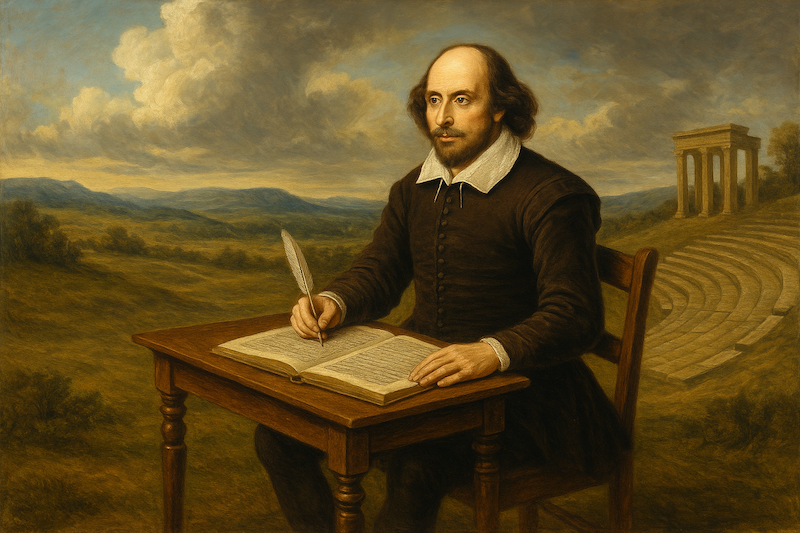
Ackroyd portrays not a divine genius floating above life, but an actor, businessman and working dramatist who navigated the vibrant, noisy streets of London. He walked among butchers and beggars, ship captains and silk merchants, lovers and lawbreakers. What he saw, he wrote. What he heard, he transformed. His theatre, The Globe, was literally circular—a metaphor for the human experience he shaped into drama.
Shakespeare is said to have created more than 1,700 new words, enriching the English language. These include popular words like majestic, lonely, eventful, radiance, and amazement, and phrases like break the ice, own flesh and blood, forever and a day, love is blind, wear my heart upon my sleeve, and the world is my oyster. To think that everyday speech today is sprinkled with the words he coined is almost haunting. It reminds us that behind every word is a mind that dared to express the unspeakable. The words Shakespeare teaches are not just tools; they are carriers of unexpressed feelings and emotions.
Ackroyd beautifully draws out how Shakespeare understood that ‘Drama is the language of the soul.’ His plays were not mere stories but cathartic journeys. The Greeks called it catharsis—the purging of emotions to restore inner balance. Shakespeare perfected it. Hamlet gives words to grief and existential despair. Othello shows how jealousy can consume dignity. King Lear explores old age, betrayal, and the tragedy of dignity stripped away. Macbeth is ambition turned into horror. The Tempest becomes forgiveness from the depths of pain. Even his comedies—As You Like It, A Midsummer Night’s Dream, and Twelfth Night—are not frivolous. Beneath the laughter lie longing, mistaken identity, the search for love and the desire for belonging. Every laugh comes with a tear. Every tragedy offers a glimpse of redemption.
We often imagine Shakespeare writing in solitude. But he was as much an actor as a playwright; his words were meant to be lived on stage. Shakespeare wrote not just to be read, but to be performed. He crafted his lines to suit the natural rhythms of spoken language and the physical movements of actors, aiming to elicit strong emotional reactions from the audience.
When we read King Henry V saying, “We few, we happy few, we band of brothers”, we hear a call to courage spoken before battle. When we read Venus saying to Adonis, “Bid me discourse, I will enchant thine ear”, we feel the seduction of language itself. When we encounter Queen Margaret telling Richard, the defeated Duke of York, “Lord, how art thou changed”, we face the fall of pride and the fragility of power. His drama becomes the mirror in which we now recognise ourselves.
It is not without reason that Shakespeare is studied today not just by literature students but also by psychologists, business leaders, spiritual thinkers and actors. He did not merely reflect life—he reframed it so we could see ourselves better. In a world moving fast, where emotional suppression equals strength, Shakespeare writes:
Give sorrow words; the grief that does not speak
Whispers the o’er-fraught heart and bids it break.
(Macbeth, Act IV, Scene 3)
Peter Ackroyd reminds us that Shakespeare lived through multiple waves of plague. Theatres would close, silence would fall, and people would turn inward. Yet, when the stage reopened, crowds gathered in the thousands. Why? Because theatre allowed them to feel again, to release their silently carried sorrow. The greatest gift an artist, author, or dramatist offers is emotional ventilation—a safe space to cry without trauma, to laugh without danger, to confront fear without consequence. When people stop feeling, they stop healing.
In our age of artificial intelligence, virtual reality and drowning distractions, we still gather to watch a play, read a book, or recite a poem. Why? Because deep within, we are Shakespearean—we want to feel, to relate, to recognise our inner tensions reflected back to us. Ackroyd shows that Shakespeare did not escape life; he entered it more fully. Each character, each soliloquy, was his way of untangling human conflict.
“To be, or not to be…” (Hamlet, Act III, Scene 1) is not a philosophical line. It is a cry from someone on the edge of despair. Who does not feel so at some stage of one’s life? No wonder actors feel possessed when performing Shakespeare’s roles. No wonder audiences don’t just watch—they internalise. The evil of Langda Tyagi, in the film Omkara, the Hindi version of Iago in Othello, is felt.
At a time when content is instant, and attention is fleeting, Shakespeare reminds us that depth matters more than speed. He teaches that the most fragile experiences, like love, guilt, longing, beauty, and sorrow, are the most powerful forces shaping human life. AI may simulate dialogue, but cannot yet simulate the tremor of Hamlet’s voice before he speaks. Technology may scale emotion, but only theatre cultivates the courage to face it.
Ackroyd concludes that around 1611, Shakespeare quietly returned to Stratford, retiring from the thunder of applause into domestic silence. He died five years later, not in glory but in stillness. Yet the world continues to speak his words even today. There is something profoundly humbling about this. Greatness does not always end in celebration; sometimes it ends in contemplation. Just as actors exit the stage while the world goes on, Shakespeare left life, having already entered eternity. He writes in his last play:
We are such stuff as dreams are made on…
(The Tempest, Act IV, Scene 1)
As I enter my seventies, I spend much of my time at home due to health reasons and find myself increasingly in the quiet company of books and thoughts. In this stillness, reading and writing—like this very blog—have become my companions and pathways to inner journeys. Shakespeare, in particular, has emerged not merely as an author from a distant era but as a fellow traveller of consciousness, a timeless soul who speaks to me across centuries. In moments of solitude, his words make me smile, stir my wonder, and gently remind me that consciousness is one—unbroken, interconnected and eternal. Though my physical world may have narrowed, my inner world expands endlessly through these conversations with his works. In these moments, I realise that not only does Shakespeare live on through his writing—he also lives quietly within me, keeping alive the joy, the curiosity and the eternal internal theatre of the human spirit.
MORE FROM THE BLOG

The Resilient Doctor
Dr. Prithvi Raj Jampana is a distinguished radiation oncologist with extensive experience in radiotherapy and systemic treatments for a wide range of cancers. He trained in clinical oncology at Oxford University Hospitals and worked in the UK for over two decades...

AI, Stories and the Mind
I have been reading an English translation of the Kathasaritsagara—The Ocean of the Streams of Stories—composed in Sanskrit by Somadeva, a Kashmiri writer of the eleventh century. Organised into eighteen books, it is less a conventional book than an immense...
The Wellness Dividend
One teaching of Dr. A.P.J. Abdul Kalam that I have always tried to follow is to ‘stay in circulation’, as he put it. By this, he did not merely mean travelling, attending meetings or remaining publicly visible. He meant keeping the mind in motion—meeting people,...
Brilliant blog Prof Tiwariji, highlighting the Shakespearean significance in digital age!
Your depiction of the creativity in the literary works of Shakespeare is outstanding!!
Dear Sir, Greetings! Thank you for sharing this excellent blog. Your reflection is profoundly moving, sir. You’ve not only captured Shakespeare’s genius, but also the emotional landscape he continues to illuminate within us. The way you connected his timeless works with your own inner journey was beautiful to read. Thank you for reminding us that literature is not just words on a page—it is a mirror, a companion, and sometimes, a healer.
Warm Regards.
Theater Within is where Shakespeare’s dramas truly come alive—not just on the stage, but in the inner auditorium of the mind. Each performance awakens an interior echo, stirring the emotions and dilemmas we carry within ourselves. Shakespeare’s worlds unfold simultaneously in the physical theatre and in the theatre of consciousness, where ambition, love, folly and moral conflict replay in personal tones. By celebrating his plays, Theatre Within celebrates this inward journey—reminding us that great drama does more than entertain; it reveals us to ourselves. Shakespeare endures because he activates that intimate stage we all possess.
Shakespeare endures because he grasped the architecture of the human spirit with uncanny precision. In today’s world—accelerated by AI, saturated with information, and fractured by distraction—his plays act as a stabilising force. They remind us that beneath technological revolutions, the same timeless currents of love, ambition, fear and wonder shape our choices. His characters are mirrors held up to our digital age, revealing that while tools evolve, human nature remains stubbornly familiar. Through him, we rediscover depth, pause, and perspective.
Reading literature is, in many ways, a quiet apprenticeship in understanding one’s own emotions. As we enter another mind’s landscape, we recognise shadows of our own—desires we never named, fears we never acknowledged, strengths we never claimed. Stories become mirrors, not just windows. Through characters’ triumphs and mistakes, our internal weather comes into view. Literature teaches us to listen inwardly, to trace the subtle shifts of feeling that daily life often blurs. In knowing them, we begin to understand ourselves—more honestly, more tenderly.
Dear Arunji, Your piece captures Shakespeare not as a distant literary monument but as a living mirror of human emotion. Through Ackroyd’s lens, he becomes a worker-poet who walked the chaos of London and turned ordinary lives into timeless theatre. You beautifully show how his words still ventilate our inner world—giving sorrow speech, giving confusion shape, giving silence depth.
In an age of speed, distraction and artificial perfection, you remind us that Shakespeare’s real gift is emotional honesty: the courage to feel. As your own world grows quieter, his voice becomes a companion—proving that great art doesn’t age; it simply moves inward, becoming part of the theatre within.
Arun Tiwari Sir’s creativity lies in transmuting the precision of missile engineering into luminous, soul-stirring prose. From mentoring young engineers at Pantnagar to co-authoring the iconic Wings of Fire with Dr. Kalam, and from inventing India’s first coronary stent to crafting books on Buddha and human values, he bridges rigorous science with profound philosophy.
In “The Theatre Within,” Arun Tiwari Sir turns personal introspection into universal catharsis, showing that true imagination can heal both arteries and spirits. Over five decades, he has consistently transformed technical precision into enduring literary fire.
May you, in your seventies and beyond, continue in robust health, with the same clarity of mind and warmth of heart that have inspired generations, for a few readers from the Pantnagar days to the countless readers touched by your words and works.
Wishing you enduring strength, unbroken creativity, and the quiet joy of knowing how profoundly you have enriched so many lives. May the theatre within keep staging masterpieces, and may every new page you write be lit with the same fire that has guided us all. With deepest respect and affection.
Arun Ji, you adore Shakespeare, but we adore you even more. The conclusion of this blog reminds us how important it is to look inwards rather than to the physical world. Thank you for sharing your thoughts.
I loved how you wove your own journey with the presence of a writer who has walked beside so many souls. The calm wisdom in your voice makes every thought feel like a gentle lantern lit in twilight. Reading your words, I sensed gratitude, curiosity, and a beautiful openness to wonder. Thank you for sharing a piece of your inner world. It feels like a gift.
Beautiful blog.
Dear Sir, Thank you for your blog. Shakespeare is one of the greatest, if not the greatest, figures in English Literature. As was very rightly pointed out, there was no special effort put into creating the epics you brought up. It must have been the natural flow God bestowed on him.
His contribution to the English language will live on forever. We cannot imagine English conversation without his words and phrases.
Your last paragraph tells how you relate yourself to him and how you enjoy his silent company. Thank you once again for an excellent topic
In solitude, we reflect many many actions which either rush or do not have time to pause.
And blessed are those who in solitude communicate with past, present and future…. AND ALSO GUIDE OTHERS TOWARDS THE PATH OF TRUTH.
Namaste Arunji.. The metaphor of life as a theatre within, with masks, roles, and scenes, resonates so deeply. Most of us often chase roles imposed from outside: success, status, approval. But rarely do we pause to meet the Being who watches behind those roles. This post is a gentle yet powerful nudge for me to remember that we are not only the actors, but also the silent audience within.
This blog captures something rare—the living pulse beneath Shakespeare’s words and the way Ackroyd brings out the human being behind the legend. Your reading of Ackroyd is enriched by your own philosophical lens. I especially loved your insight that ‘when people stop feeling, they stop healing.’ In an age of speed and screens, this reminder feels almost medicinal.
Your reflections weave history, biography and personal introspection together so gracefully. The connection you draw between Shakespeare’s catharsis and our present need for emotional ventilation is profound.
Reading the blog felt like entering a gentle conversation across centuries. Your reflections bridge 400 years effortlessly. The idea that Shakespeare lives ‘quietly within us’ is one of the most profound takeaways.
There is a quiet power in the way you relate Shakespeare’s emotional landscape to your own contemplative years. The parallel between his late-life retreat to Stratford and your reflective inner journey is deeply touching. This blog reminds us that solitude is not emptiness—it is expansion.
You have shown that Shakespeare’s genius did not lie in escaping the turbulence of life but in engaging with it deeply. Your own journey into the ‘theatre within’ echoes the same courage and curiosity that shaped his work.
The blog reveals how Shakespeare becomes a companion rather than a distant literary figure. The passages on catharsis and the fragility of human emotions are especially resonant today. Thank you for articulating so beautifully why theatre—and art itself—remains vital in a digital age.
Dear Prof, Thank you for sharing these personal moments and for the inspiration from Shakespeare’s work. It gives me joy to know that Shakespeare’s experience and expressions of himself in the stillness of life apply to you and those of us ageing gracefully …
Arun, I visited Stratford-on-Avon a few years back and was impressed by how they put on their dramas every day in that small village. I visited his house, his wife’s past residence, and also the theatre in his name. I find his language difficult to follow because it is called medieval English. My original option before entering medical studies was to do English literature and teach Shakespeare and the poet Keats. I had two great English teachers at Loyola College, Vijayawada, during my studies there. I appreciate your interpretation of Shakespeare in a modern context
Dear Arun ji, As usual, profound truth unveiled!
This stirred something in me — the theatre within is where I return to realign with why I do what I do.
Pursuing the purpose with passion!
Outside, there’s noise, but we need to reflect deep within!! Calibration !! Grateful sir!
Prof Tiwari, while the blog reflects on what literature should be and do to us, I live in the reality of “Though my physical world may have narrowed, my inner world expands endlessly through these conversations with his works. In these moments, I realise that not only does Shakespeare live on through his writing—he also lives quietly within me, keeping alive the joy, the curiosity and the eternal internal theatre of the human spirit”. Hoping that this challenge draws the true colours of goodness God endowed you with. Thank you, my dear friend.